|
Nashua's Early History
"This is a prosperous and important town near the southwest corner of the county. It is situated in a bend of the Cedar River, directly opposite the confluence of the Little Cedar, and at the foot or south end of the heaviest body of timber in Chickasaw County. The town plat lies in the river valley on dry ground sufficiently high to be above the reach of floods with a gentle inclination eastward.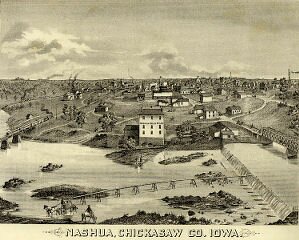 It is a beautiful location, which is thoroughly protected from high winds in every direction by high ground covered with timber. The Cedar River affords very valuable and excellent water power on the north side, just above the railroad bridge, which is occupied by one of the largest and best flouring mills in northern Iowa." Source: A.T. Andreas Illustrated Historical Atlas of the State of Iowa 1875 Quotation and maps courtesy of IAGenweb.org It is a beautiful location, which is thoroughly protected from high winds in every direction by high ground covered with timber. The Cedar River affords very valuable and excellent water power on the north side, just above the railroad bridge, which is occupied by one of the largest and best flouring mills in northern Iowa." Source: A.T. Andreas Illustrated Historical Atlas of the State of Iowa 1875 Quotation and maps courtesy of IAGenweb.org
The early history of Nashua began with the establishment of the first business on the west bank of the Cedar River and the building of a log cabin by John Hall in 1854. A few other families moved in and by 1856, Andrew Sample owned the land on which the town was platted and Enoch Woodbridge became part owner.
Woodbridge and Sample were instrumental in laying out the town. The town was first called Bridgeport, then changed to Woodbridge. In 1857 the name was changed to Nashua because of the discovery that there was another town in Iowa already named Woodbridge.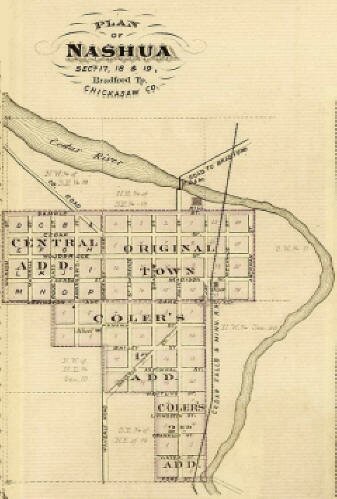 Two prominent families, Edward P. and Charles Greeley had come from Nashua, New Hampshire and were instrumental in naming this town after their original home. The streets of Woodbridge, Sample and Greeley in Nashua are named after these prominent founders. Two prominent families, Edward P. and Charles Greeley had come from Nashua, New Hampshire and were instrumental in naming this town after their original home. The streets of Woodbridge, Sample and Greeley in Nashua are named after these prominent founders.
In 1857 a hotel was built by J.D. Hall, called The Montgomery House. By 1858 the early businesses were a grocery store by Smiley Sample, general merchandise stores by E.P. Greeley, Veter & Ripe, Trott & Green, George T. Butterfield, Enoch Woodbridge, Elihu Hall, George Fountain and James A. Webster. The first grist mill was erected by Andrew Sample. A steam saw mill was built in 1858 by Charles Greeley and Edward P. Greeley, it operated only a few years.
The first newspaper was published May 22, 1867 and reported that at that time Nashua had good water power from a dam across the river, excellent stands of timber, a brick yard, and a woolen factory was being organized. In 1867 mail came from the north daily and tri-weekly from West Union.
In 1867 the population of Nashua was 600 with 160 students in school. In 1869 the first school building was erected with bricks from the local brickyard and in 1885 the first class graduated from the Nashua High School
It was largely through the influence of the Greeleys that the railroad came to Nashua. In 1868 the Cedar Valley and Minnesota Branch of the Illinois Central Railroad built a line through Nashua, giving the town an important place on the railroad map and is still in use today. In 1868 a depot was also built for the railroad. A wooden bridge was constructed across the river.
The city was incorporated in 1869 with the first mayor being, T. S. Bradford. In 1875 the first bank was established. By 1898 a creamery, pickle factory and two cemeteries had been added to the town’s resources. A brick power house was built in 1912. In 1902 the Nashua Public Library was founded by the citizens of Nashua. In 1905 a new building was erected for $6000.00 from a grant received from Andrew Carnegie.  It is a stately brick building built up on a hill with two stories and a basement. It is decorated inside with beautiful wood. It was dedicated on January 10, 1906. In 1914, Librarian Fanny V. Eastman reported there were 3,253 volumes in the library. In 1986 a new addition was added on at ground level and the original library closed, but can still be toured. It is a stately brick building built up on a hill with two stories and a basement. It is decorated inside with beautiful wood. It was dedicated on January 10, 1906. In 1914, Librarian Fanny V. Eastman reported there were 3,253 volumes in the library. In 1986 a new addition was added on at ground level and the original library closed, but can still be toured.
The early churches were, The Congregational organized in 1866 and the building erected in 1870. Methodist Episcopal incorporated and built in 1869 and St Michael’s Catholic incorporated and built in 1873. The historic Little Brown Church in the Vale is located two miles outside of town and was organized on November 4, 1855 and built and dedicated by December 29, 1864.
Back to Top
|